
What Is Blockchain – If you’ve heard about Bitcoin, Ethereum, Solana, NFTs, or cryptocurrencies, you’ve almost certainly come across the word blockchain.
But what exactly is blockchain?
Many people assume blockchain is simply another name for cryptocurrency. In reality, blockchain is the technology that makes cryptocurrencies possible—and its potential extends far beyond digital money.
Today, blockchain is transforming industries including finance, healthcare, logistics, gaming, digital identity, and artificial intelligence.
In this beginner’s guide, we’ll explain blockchain in simple language, explore how it works, and discover why many experts believe it will become one of the defining technologies of the 21st century.
What Is Blockchain?
A blockchain is a digital ledger that securely records information across a decentralized network of computers.
Instead of storing data in one central location, blockchain distributes copies of the same ledger across thousands of computers worldwide.
Every participant sees the same history of transactions.
Once information is added and verified, it becomes extremely difficult to alter or remove.
This combination of transparency, security, and decentralization makes blockchain fundamentally different from traditional databases.
Why Is It Called a Blockchain?
The name comes from the way information is stored.
Data is grouped into blocks.
Each block contains information such as:
- Transactions
- Timestamp
- Cryptographic fingerprint (hash)
- Reference to the previous block
Each new block links to the one before it.
Over time, these linked blocks form a continuous chain.
This structure protects the integrity of the data because changing one block would require changing every block that follows it across thousands of computers simultaneously.
How Does Blockchain Work?
Although blockchain technology is highly sophisticated, its basic process is surprisingly easy to understand.
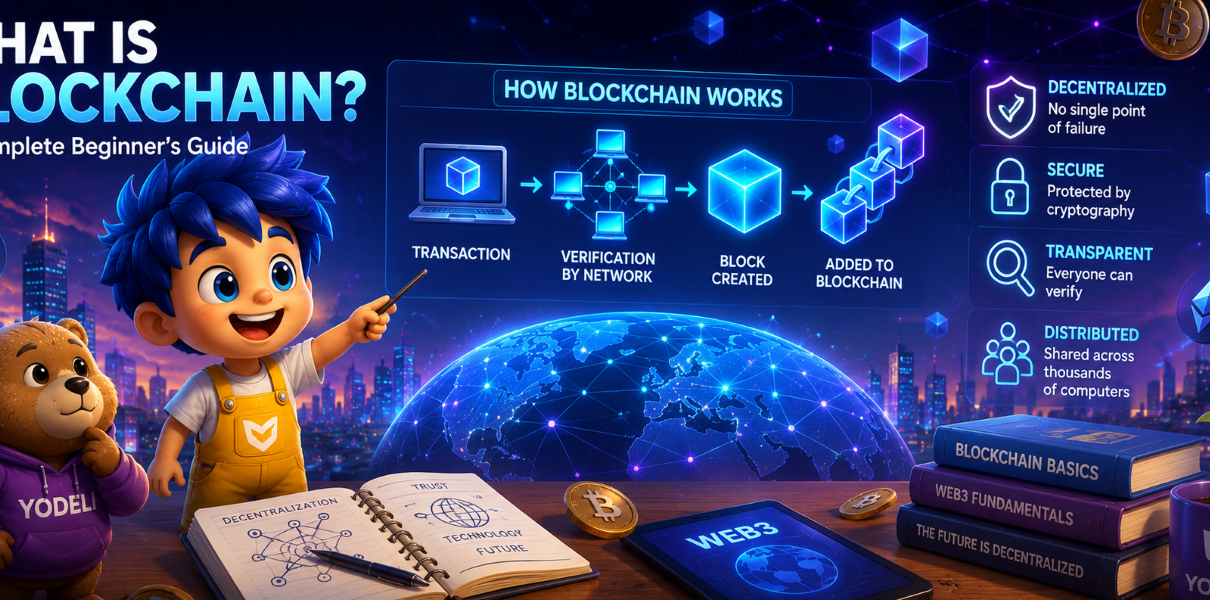
Step 1 – A Transaction Begins
Someone sends cryptocurrency, stores information, or interacts with a blockchain application.
The network receives the request.
Step 2 – The Network Verifies It
Computers called nodes independently verify that the transaction follows the blockchain’s rules.
Instead of trusting one central authority, thousands of participants work together to validate the information.
Step 3 – The Transaction Is Added to a Block
Verified transactions are grouped together into a new block.
Step 4 – The Block Joins the Chain
After verification, the new block becomes permanently connected to the existing blockchain.
Everyone’s copy of the ledger updates simultaneously.
Step 5 -The Record Becomes Permanent
Once confirmed, the information becomes extremely difficult to modify.
This creates a transparent and reliable history that anyone can verify.
Why Is Blockchain Secure?
Security is one of blockchain’s greatest strengths.
Several features work together to protect the network.
Cryptography
Advanced mathematical encryption secures every transaction.
Decentralization
Instead of relying on one central server, thousands of independent computers maintain the network.
There is no single point of failure.
Consensus
Before new information is accepted, the network agrees that it is valid.
Different blockchains use different consensus methods to achieve this agreement.
Transparency
Most public blockchains allow anyone to view transaction history while preserving user privacy.
Blockchain vs Traditional Databases
| Traditional Database | Blockchain |
|---|---|
| Centralized | Decentralized |
| Controlled by one organization | Shared across thousands of participants |
| Records can often be modified | Records are designed to be tamper-resistant |
| Requires trust in a central authority | Trust is distributed across the network |
| Limited transparency | High transparency on public blockchains |
What Can Blockchain Be Used For?
While cryptocurrencies are the best-known application, blockchain technology supports far more.
Digital Payments
Fast global transactions without relying on traditional banking infrastructure.
Smart Contracts
Self-executing agreements that automatically perform actions when predefined conditions are met.
Supply Chains
Businesses can track products from manufacturing to delivery with greater transparency.
Healthcare
Medical records can be shared securely while giving patients greater control over their information.
Digital Identity
Individuals may one day manage their identity securely without relying on multiple centralized databases.
Gaming
Players can truly own in-game assets and trade them across compatible ecosystems.
Tokenization
Real-world assets such as artwork, property, or collectibles can be represented digitally on a blockchain.
Popular Blockchain Networks
Different blockchains are designed for different purposes.
Bitcoin
The world’s first blockchain, primarily focused on secure digital money.
Ethereum
Introduced smart contracts and decentralized applications.
Solana
Known for high speed, low transaction costs, and a rapidly growing ecosystem of developers, NFTs, DeFi platforms, and community-driven projects.
Polygon
Designed to improve scalability and reduce costs for Ethereum-based applications.
Avalanche
A blockchain platform optimized for speed, scalability, and customizable networks.
Each blockchain has unique strengths, and developers choose the one that best fits their project’s goals.
Why Does Blockchain Matter?
Blockchain represents a shift in how people exchange value and information online.
Instead of depending on centralized intermediaries, blockchain enables direct interaction between participants.
Potential benefits include:
- Greater transparency
- Enhanced security
- Improved efficiency
- Reduced costs
- Global accessibility
- Increased user ownership
As adoption continues to grow, blockchain could reshape many aspects of the digital economy.
Common Blockchain Myths
“Blockchain Is Only for Cryptocurrency”
False.
Blockchain powers applications in finance, logistics, healthcare, gaming, digital identity, and many other sectors.
“Blockchain Is Anonymous”
Most public blockchains are pseudonymous rather than anonymous.
Transactions are visible, but wallet addresses are not automatically linked to real-world identities.
“Blockchain Can Never Be Hacked”
The technology is highly secure, but applications, wallets, and user practices can still be vulnerable.
Security depends on both the blockchain and how it is used.
The Future of Blockchain
Blockchain adoption continues to accelerate across industries.
Emerging trends include:
- Artificial Intelligence and blockchain integration
- Tokenized real-world assets
- Decentralized finance (DeFi)
- Digital identity solutions
- Supply chain transparency
- Cross-border payments
- Decentralized autonomous organizations (DAOs)
As infrastructure improves, blockchain may become as essential to the internet as cloud computing is today.
Why YodeliCoin Supports Blockchain Education
At YodeliCoin, we believe that education is one of the most important drivers of blockchain adoption.
Understanding how blockchain works empowers people to make informed decisions, explore new technologies, and participate confidently in the evolving Web3 ecosystem.
Through our educational content, we aim to make blockchain concepts accessible to everyone—from complete beginners to curious innovators.
Because the future of blockchain isn’t just about technology.
It’s about the people who learn, build, and grow together.
Final Thoughts
Blockchain is much more than the technology behind cryptocurrencies.
It is a new way of recording information, exchanging value, and building trust in a digital world.
Whether you’re exploring crypto for the first time or learning about Web3, understanding blockchain provides the foundation for everything that follows.
As innovation continues, blockchain is likely to become an increasingly important part of everyday life—and there’s never been a better time to start learning.